
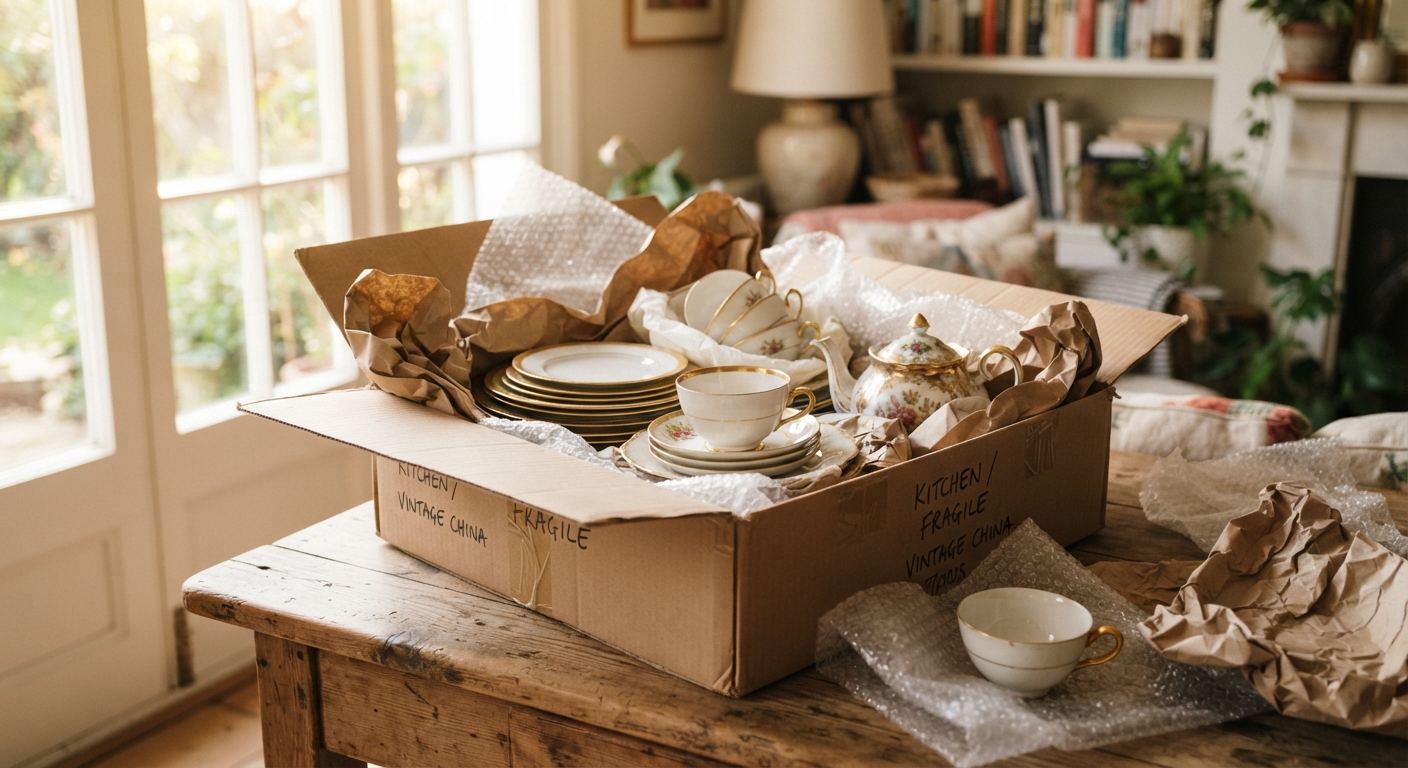
How to Pack Fragile Items for a Move: A Step-by-Step Guide
To pack fragile items safely, use strong double-walled boxes, wrap each item individually, fill every gap so nothing can move, and label the box clearly as fragile. Heavy items go at the bottom and light items on top. Most breakages during a move happen because items shift inside the box, so a snug, well-padded fit matters more than anything else.
This guide covers what you need, how to wrap different items, and how to label and load boxes so your belongings arrive in one piece.
What materials do you need to pack fragile items?
Good materials make the biggest difference. Gather these before you start:
- Strong cardboard boxes, ideally double-walled for glass, china and anything heavy
- Bubble wrap for items that need cushioning
- Packing paper (plain, unprinted) for wrapping plates, glasses and ornaments
- Packing tape to seal boxes securely, including the base
- Cardboard dividers for glasses and bottles
- Fragile stickers and a thick marker pen
- Soft fillers such as towels, linen or clothes to fill gaps
Avoid reusing old, worn or damp boxes. A box that has lost its strength can collapse under weight, especially when stacked.
How do you prepare a box for fragile items?
Preparing the box properly gives your items a safe base.
- Tape the bottom of the box with at least two strips across the seam, plus a cross-pattern for extra strength.
- Add a cushioning layer of crumpled packing paper or bubble wrap, roughly 5 cm deep.
- Choose the right size. A small box is better for heavy fragile items such as books of glassware or ceramics. A large box full of china becomes too heavy to carry safely.
How do you wrap fragile items step by step?
Follow the same method for most breakable items:
- 1. Lay the item in the centre of a sheet of packing paper.
- 2. Fold the corners over the item and roll it up, tucking in the ends.
- 3. Add a layer of bubble wrap and secure it with tape.
- 4. Place it in the box, then fill any space around it.
Wrap every item individually. Two items wrapped together can knock against each other and break.
How do you pack specific fragile items?
Plates and dishes
Wrap each plate separately and stack them on their edge, like records, not flat. Plates are far stronger on their edge than when stacked flat. Add padding between each one and at the top and bottom of the box.
Glasses and stemmed glassware
Stuff the inside of each glass with packing paper, then wrap the outside. Wrap stems with extra care, as they are the weakest part. Use cardboard dividers if you have them, and always pack glasses upright or on their side, never upside down on the rim.
Mugs and cups
Wrap each one individually, put a little paper inside, and nest them carefully with padding between layers. Wrap handles separately, as they snap easily.
Framed pictures and mirrors
Cover the glass with a cross of masking tape to hold it together if it cracks. Wrap in bubble wrap, then place in a flat, picture-specific or mirror box. Pack them upright on their edge, never flat, and never with heavy items against them.
Electronics and TVs
Use the original box if you still have it. If not, wrap the device in a soft blanket or bubble wrap and use a sturdy box. Take photos of cable connections before unplugging, and bag the cables with labels. Remove batteries from devices before packing.
Lamps, ornaments and decorative pieces
Remove lampshades and bulbs and pack them separately. Wrap ornaments and delicate decorations in several layers of paper, with extra padding around any thin or protruding parts.
Liquids and bottles
Make sure lids are tightly closed and seal them with tape or cling film. Place bottles upright and pack them in a separate box from other fragile items, in case of leaks.
How do you fill the gaps in a box?
This step is easy to rush, but it protects your belongings most. Once the box is packed, give it a gentle shake. If you can feel or hear anything moving, add more padding.
Use crumpled paper, towels, tea towels or soft clothing to fill every space. The box should be firm when you close it, but not bulging. If the lid is bowing upwards, the box is overfilled and the contents could be crushed when stacked.
How should you label boxes containing fragile items?
Clear labelling helps everyone who handles the box.
- Write FRAGILE on the top and at least two sides.
- Add “This way up” arrows.
- Note the room the box belongs in.
- Number your boxes and keep a simple list of contents.
Put the most delicate boxes last in the van or in a spot where they cannot be crushed, and tell your movers which boxes need extra care.
How should fragile boxes be loaded into a van?
Even perfect packing can fail if boxes are loaded badly.
- Place heavier boxes at the bottom and lighter, fragile boxes on top.
- Keep fragile boxes away from sharp edges and loose furniture.
- Pack boxes tightly so they cannot slide during the journey.
- Never stack heavy items on top of boxes marked fragile.
If you are using a professional removals team, point out the delicate boxes before loading starts so they can be placed with care.
Common mistakes to avoid
- Using boxes that are too big or too weak
- Leaving empty space inside boxes
- Stacking plates flat
- Using newspaper directly on delicate surfaces, as the ink can mark items (plain packing paper is better)
- Packing everything the night before the move
- Forgetting to label the box clearly
Frequently asked questions
- What is the best way to pack fragile items for moving?
Wrap each item individually in packing paper and bubble wrap, place it in a strong box lined with padding, fill all gaps, seal the box securely and label it as fragile.
- Is bubble wrap or packing paper better for fragile items?
Use both. Packing paper is ideal for the first layer around the item, and bubble wrap adds extra cushioning for shock protection.
- Should I pack plates flat or on their edge?
Pack plates on their edge. They are much stronger standing upright than stacked flat.
- How much padding should I use in a box?
Enough that nothing moves when you gently shake the box. Include a layer at the bottom, between items, and on top.
- When should I start packing fragile items?
Start at least one to two weeks before moving day. Pack delicate and rarely used items first, so you are not rushing at the last minute.
- Can I pack fragile items with clothes?
Yes. Soft clothes, towels and linen make excellent padding, as long as the box is not so heavy that it becomes hard to lift.
Final thoughts
Packing fragile items takes a little extra time, but it is the best way to protect the things that matter most. Use strong boxes, wrap items individually, fill all gaps and label clearly, and your belongings are far more likely to arrive safely.